Products
Industry news
Industry news

What Is LiFePO4 Battery Technology and Why Is It Still Evolving?

Date:2026-08-24

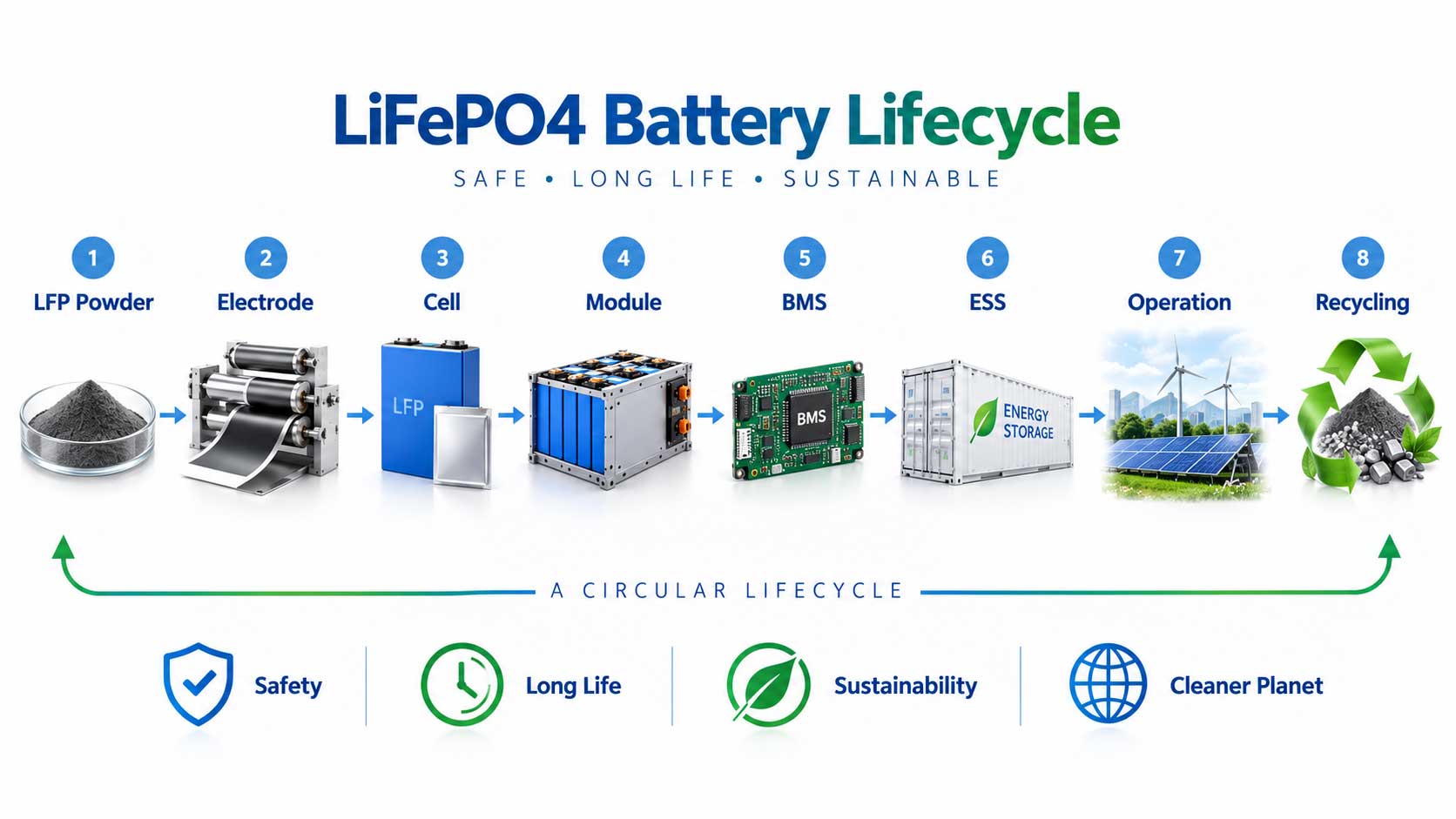
LiFePO4 battery technology is often described as mature. For a procurement team, that can sound as if the engineering work is finished. It is not. The core cathode chemistry is proven, but a commercial battery is a chain of decisions: powder, electrode, cell, module, BMS, enclosure, field operation, and end-of-life handling. Nature Portfolio research shows that every link is still being refined, from particle-level phase control to thick-electrode manufacturing, solid-state interfaces, recycling, health estimation, and earlier safety warning [1-20].

From a market director‘s perspective, this is good news for overseas B2B buyers. It means LFP is not a short-lived trend. It is a scalable platform with a mature commercial base and a visible innovation roadmap. The important question is not simply, ‘Is this an LFP battery?‘ It is, ‘How well has the entire energy storage battery system been engineered and validated for my operating profile?‘

What Is LiFePO4 Battery Technology?

A stable lithium-ion chemistry built around iron phosphate

LiFePO4, commonly shortened to LFP, is a lithium-ion cathode material with an olivine crystal structure. During charging, lithium ions move from the LFP cathode toward a graphite anode; during discharge, they move back. The phosphate framework contains strong phosphorus-oxygen bonds, which helps the cathode remain structurally and thermally stable. LFP also avoids nickel and cobalt in the cathode, supporting a different cost and supply-chain profile from nickel-rich chemistries.

A LiFePO4 battery is still a lithium-ion battery. It still includes an anode, separator, electrolyte, current collectors, tabs, seals, and electrical connections. At pack level, it also needs sensing, contactors, fusing, thermal design, software, communications, and a protective enclosure. This distinction matters: a safer cathode chemistry does not eliminate all electrical, mechanical, or thermal hazards.

Why LFP fits stationary energy storage

Stationary buyers usually optimize for total cost of ownership, usable life, safety, serviceability, and supply continuity rather than maximum gravimetric energy density. That makes LFP attractive for solar storage, commercial and industrial systems, telecom backup, UPS, microgrids, and containerized BESS. However, chemistry alone does not determine field performance. Cell consistency, operating SOC window, temperature, current profile, balancing, thermal management, and commissioning practices can be just as important as the label on the cathode.

Why Is a Mature LFP Platform Still Evolving?

1. LFP material engineering is moving from chemistry labels to process control

Nature Portfolio studies have visualized how lithium-rich and lithium-poor phases develop inside LFP particles and across an electrode. The reaction can be uneven, especially as rate changes [1]. Other work shows that carbon coating, a standard method for improving conductivity, can also create secondary phases depending on particle size, temperature, and atmosphere [2]. A 2026 study on copper-doped LFP links local structural disorder with faster lithium transport, illustrating why doping and defect engineering remain active research areas [3].

The commercial lesson is straightforward: ‘LFP grade‘ is not a complete specification. A responsible LFP battery manufacturer must control particle-size distribution, carbon-coating quality, impurities, moisture, slurry dispersion, calendaring, electrolyte wetting, and formation. Conventional LFP powder and carbon-coating processes are commercially mature (M1-M2). Specific advanced doping routes reported in research should be treated as pilot or exploratory (M3-M4) until manufacturability, consistency, cost, full-cell behavior, and long-term qualification are demonstrated.

2. Thick electrodes can raise cell efficiency, but transport becomes harder

Thicker electrodes place more active material on each current collector. In principle, that reduces the share of inactive components and can improve cell-level energy and manufacturing efficiency. The trade-off is that lithium ions must travel through a longer, more complex porous network. Wetting, concentration gradients, local heating, and reaction non-uniformity become more difficult to control.

Nature Portfolio papers have explored water-based LFP slurries with three-dimensional current collectors [4], laser-structured low-tortuosity thick LFP electrodes [5], and solvent-free dry thick-electrode manufacturing in another cathode chemistry [6]. The last example is useful as a manufacturing trend, not as direct LFP performance evidence. For buyers, the key questions are areal loading, porosity, electrolyte fill and wetting time, rate behavior, low-temperature behavior, high-temperature aging, production yield, and whether the test cell matches the offered product. High-loading wet-coated LFP is in industrial optimization (M2); laser-structured and advanced dry routes are generally emerging (M3).

3. Solid-state LFP is promising, but it is not one single product

Solid-state designs replace some or all liquid electrolyte with a solid ion conductor. The promise is compelling, but the practical challenge is contact. A solid cathode must maintain continuous pathways for both ions and electrons while interfaces expand, contract, and age. Nature Portfolio research has demonstrated solution-processable solid catholytes compatible with LFP [7] and a phase-separated polymer electrolyte in laboratory lithium-metal/LFP cells [8]. A broader perspective identifies remaining gaps in polymer conductivity, interface stability, processing, and complete-cell design [9].

What Is LiFePO4 Battery

The architecture must always be stated. The 2026 polymer study used a lithium-metal anode, not the conventional graphite anode used in most commercial LFP energy storage battery systems. Separate research on sulfide solid-state cells also shows that a solid electrolyte does not automatically remove thermal-runaway risk; interfacial reactions can still matter [10]. For mainstream stationary procurement, conventional liquid-electrolyte LFP is commercially mature (M1). The specific solid-state LFP routes discussed here are pilot to exploratory (M3-M4) and should be evaluated as a roadmap, not presented as an automatic near-term replacement.

4. Recycling is evolving because LFP economics differ from nickel-rich batteries

Traditional pyrometallurgical and hydrometallurgical routes are established, but LFP contains less high-value metal than nickel- and cobalt-bearing cathodes. That changes the business case. Nature Portfolio research has shown direct regeneration of degraded LFP by restoring lithium content, structure, and the conductive carbon network [11]. Other work models when reuse should come before recycling [12], while a 2026 redox-targeting concept processes spent LFP together with layered oxides in a closed-loop electrochemical system [13].

For an overseas buyer, end-of-life planning should include traceability, state-of-health screening, chemistry sorting, regional take-back partners, transportation rules, and data ownership. Industrial pyro and hydro routes are mature to scaling (M1-M2). Direct regeneration and newer closed-loop concepts are emerging (M3) because feedstock variability, contamination, qualification of regenerated material, logistics, and economics still need broader commercial proof.

5. BMS development continues because LFP voltage is informative but not simple

LFP has a long, relatively flat voltage plateau. That is useful for stable output, but it makes state-of-charge estimation harder because a small voltage difference can correspond to a meaningful change in SOC. Hysteresis also means the relaxed voltage can depend on whether the cell arrived there from charging or discharging. Nature Portfolio research therefore combines physics-based phase-transition models with machine learning for LFP/graphite cells [14].

Data-driven work has also shown the potential to predict lifetime from early-cycle information in commercial LFP/graphite cells [15]. The paper supplied for this article evaluates SOH estimation from partial charging segments using transfer learning and a public fast-charging dataset [16]. Another study uses physics-informed neural networks to improve stability and generalization of degradation prognosis [17]. These results support an R&D direction; they do not establish universal BMS accuracy across every cell, temperature, duty cycle, or pack architecture.

Core protections, current and voltage measurement, balancing, contactor control, thermal limits, alarms, and CAN or RS485 communications are commercially mature (M1). Advanced partial-charge SOH estimation, physics-informed models, and cross-platform diagnostics are industrial optimization to emerging (M2-M3). A buyer should ask whether algorithms were trained and validated on the exact cell platform, temperature range, aging window, and partial-cycle behavior used in the project. The label ‘smart BMS‘ is not evidence by itself.

6. LFP safety is an advantage, not a substitute for system engineering

LFP is widely selected because its cathode is more thermally stable than many nickel-rich alternatives. Yet Nature Portfolio studies show why safety must still be engineered at cell, module, rack, and site level. Mechanical abuse can create an internal short circuit and thermal runaway even in prismatic LFP cells [18]. Operando fiber sensors have captured internal temperature and pressure changes in commercial LFP cells before visible failure signals [19]. Printable multifunctional sensor arrays represent another emerging route to earlier hazard detection [20].

For a B2B project, safety should be treated as layers: cell consistency, insulation, spacing, fusing, contactors, BMS logic, thermal management, vent paths, propagation control, enclosure design, installation, monitoring, and emergency response. Established pack protection and thermal engineering are mature (M1-M2); embedded cell-level sensing is emerging (M3). Buyers should request test evidence for the offered cell, module, rack, and system configuration rather than accepting a chemistry-level safety statement.

Technology Maturity Map for B2B Buyers

A practical maturity view keeps research exciting without turning it into an unsupported product claim:

M1 - Commercially mature: conventional LFP/graphite cells with liquid electrolyte; standard wet-coated electrodes; core BMS protection; established pack integration and industrial recycling routes.

M2 - Industrial optimization: advanced carbon and particle process control; higher-loading wet electrodes; higher-fidelity electrochemical and thermal models; stronger propagation and system-level safety design.

M3 - Pilot or emerging: laser-structured or advanced dry thick electrodes; direct LFP cathode regeneration; partial-charge SOH models across broader field conditions; embedded multifunctional sensing.

M4 - Exploratory: the specific solid-state lithium-metal/LFP and novel electrolyte architectures highlighted in the cited papers, pending practical loading, pressure, interface, yield, safety, cost, and long-duration field validation.

What Should Buyers Ask an LFP Battery Manufacturer?

A serious sourcing process should connect the application profile to evidence. Define the usable energy, charge and discharge power, cycle pattern, SOC window, ambient and cell temperature, expected calendar life, installation altitude, communications, redundancy, maintenance model, and end-of-life route. Then ask the supplier to show how the proposed design was validated against those conditions.

The evidence package should identify the exact cell and pack configuration; cell matching and traceability controls; incoming and end-of-line tests; BMS protection thresholds and communication map; thermal and fault-response logic; relevant electrical, environmental, transport, and abuse testing; degradation and warranty assumptions; change-control procedures; and recycling or take-back arrangements where applicable. Certification statements should name the standard, product scope, laboratory or certification body, and report or certificate reference. A generic badge or a report for a different configuration is not enough.

The Bottom Line

LiFePO4 battery technology is still evolving because the market is no longer optimizing only the cathode. It is optimizing the whole lifecycle: material consistency, electrode architecture, manufacturing efficiency, digital diagnostics, pack safety, and circularity. The best LFP battery manufacturer is not the one that repeats the most impressive research headline. It is the one that translates a mature chemistry and an honest technology roadmap into application-specific, traceable evidence for the buyer‘s energy storage battery project.

LiFePO4 Battery Lifecycle

FAQ

1. Is a LiFePO4 battery the same as a lithium-ion battery?

LiFePO4 is one type of lithium-ion battery chemistry. The name identifies the iron-phosphate cathode, while the complete cell also contains an anode, electrolyte, separator, current collectors, and safety components. Therefore, LFP shares many system-level requirements with other lithium-ion batteries even though its cathode has a different safety, cost, and performance profile.

2. Why does an LFP battery still need a BMS if it is safer?

A safer cathode does not prevent overcharge, over-discharge, external short circuit, connector faults, cell imbalance, sensor failure, or extreme temperature. The BMS measures and controls the system, isolates faults, manages balancing and contactors, communicates with the inverter or EMS, and supports diagnostics. It is a core safety layer, not an optional accessory.

3. Are thick LFP electrodes commercially ready?

High-loading wet-coated LFP electrodes are already part of industrial optimization, but ‘thicker‘ is not automatically better. The design must preserve wetting, ion transport, thermal uniformity, power capability, life, and production yield. Laser-structured and advanced dry thick electrodes are promising emerging routes, but buyers should request product-specific validation rather than extrapolate from a laboratory paper.

4. Is solid-state LFP ready for large energy storage projects?

Solid-state LFP has credible laboratory and pilot research, but the cited architectures differ from today‘s mainstream graphite/LFP storage cells. Interface stability, pressure, practical loading, manufacturing yield, safety behavior, cost, and field duration still require qualification. For most current projects, solid-state LFP is a technology roadmap item rather than a blanket replacement for commercial liquid-electrolyte LFP.

5. How should I compare two LFP battery manufacturers?

Compare the evidence behind the offer: exact cell platform, consistency and traceability, usable-energy definition, duty-cycle testing, thermal design, BMS functions and communications, safety and environmental test scope, warranty assumptions, change control, service model, and end-of-life plan. Price per nominal kilowatt-hour alone can hide major differences in usable performance, risk, and lifecycle cost.


Research & Citation Disclosure

All sources below are Nature Portfolio journal articles or perspectives. DOI links are included for editorial review and website-source attribution. Accessed and checked on 23 August 2026.

References

  1. Wang, J., Chen-Wiegart, Y.-C. K. & Wang, J. "In operando tracking phase transformation evolution of lithium iron phosphate with hard X-ray microscopy." Nature Communications 5, 4570 (2014).
  2. Liu, Y. et al. "Formation of size-dependent and conductive phase on lithium iron phosphate during carbon coating." Nature Communications 9, 929 (2018).
  3. Kumar, D. et al. "Enhanced kinetics in Cu-doped LiFePO4 cathodes due to local structural disorder." Communications Materials 7, 185 (2026).
  4. Aguilo-Aguayo, N. et al. "Water-based slurries for high-energy LiFePO4 batteries using embroidered current collectors." Scientific Reports 10, 5565 (2020).
  5. Wu, J. et al. "Fabrication of low-tortuosity thick electrodes with low material loss by temporally shaped ultraviolet femtosecond laser." Nature Communications 17, 973 (2026).
  6. Kim, M. K. et al. "Fluorine-free binder-based dry thick electrodes with Parafilm M toward sustainable and efficient battery manufacturing." Nature Communications 16, 11174 (2025).
  7. Li, J. et al. "Room temperature all-solid-state lithium batteries based on a soluble organic cage ionic conductor." Nature Communications 13, 2031 (2022).
  8. Zhang, S. et al. "Tailoring electrolyte phase separation for high-rate solid-state lithium metal batteries." Nature Communications 17, 7310 (2026).
  9. Song, Z. et al. "A reflection on polymer electrolytes for solid-state lithium metal batteries." Nature Communications 14, 4884 (2023).
  10. Wu, Y. et al. "Electrochemical initiation and chemical reaction cascades in dual-stage thermal runaway in sulfide-based all-solid-state batteries." Nature Communications 17, 2928 (2026).
  11. Ji, G. et al. "Direct regeneration of degraded lithium-ion battery cathodes with a multifunctional organic lithium salt." Nature Communications 14, 584 (2023).
  12. Ma, R. et al. "Pathway decisions for reuse and recycling of retired lithium-ion batteries considering economic and environmental functions." Nature Communications 15, 7641 (2024).
  13. Huang, S. et al. "Self-driven recycling of spent Li-ion battery materials with electricity generation." Nature Communications 17, 2996 (2026).
  14. Pozzato, G. et al. "Accelerating the transition to cobalt-free batteries: a hybrid model for LiFePO4/graphite chemistry." npj Computational Materials 10, 14 (2024).
  15. Severson, K. A. et al. "Data-driven prediction of battery cycle life before capacity degradation." Nature Energy 4, 383-391 (2019).
  16. Li, Y. et al. "Transfer learning-based SOH estimation from partial charging data with polarization-aware modeling." Scientific Reports 16, 23076 (2026).
  17. Wang, F. et al. "Physics-informed neural network for lithium-ion battery degradation stable modeling and prognosis." Nature Communications 15, 4332 (2024).
  18. Chai, Z. et al. "Experimental analysis and safety assessment of thermal runaway behavior in lithium iron phosphate batteries under mechanical abuse." Scientific Reports 14, 8673 (2024).
  19. Mei, W. et al. "Operando monitoring of thermal runaway in commercial lithium-ion cells via advanced lab-on-fiber technologies." Nature Communications 14, 5251 (2023).
  20. Sun, N. et al. "Fully printable integrated multifunctional sensor arrays for intelligent lithium-ion batteries." Nature Communications 16, 7361 (2025).

Final compliance statement

This document is a research-informed marketing draft, not a product data sheet, certification statement, engineering sign-off, or warranty. Any public claim about a specific battery must be checked against the exact cell, pack configuration, test method, operating conditions, report scope, and current certification status.