


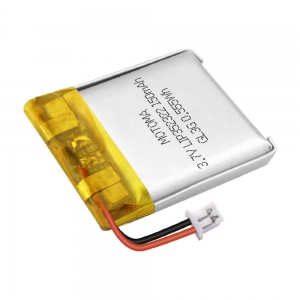





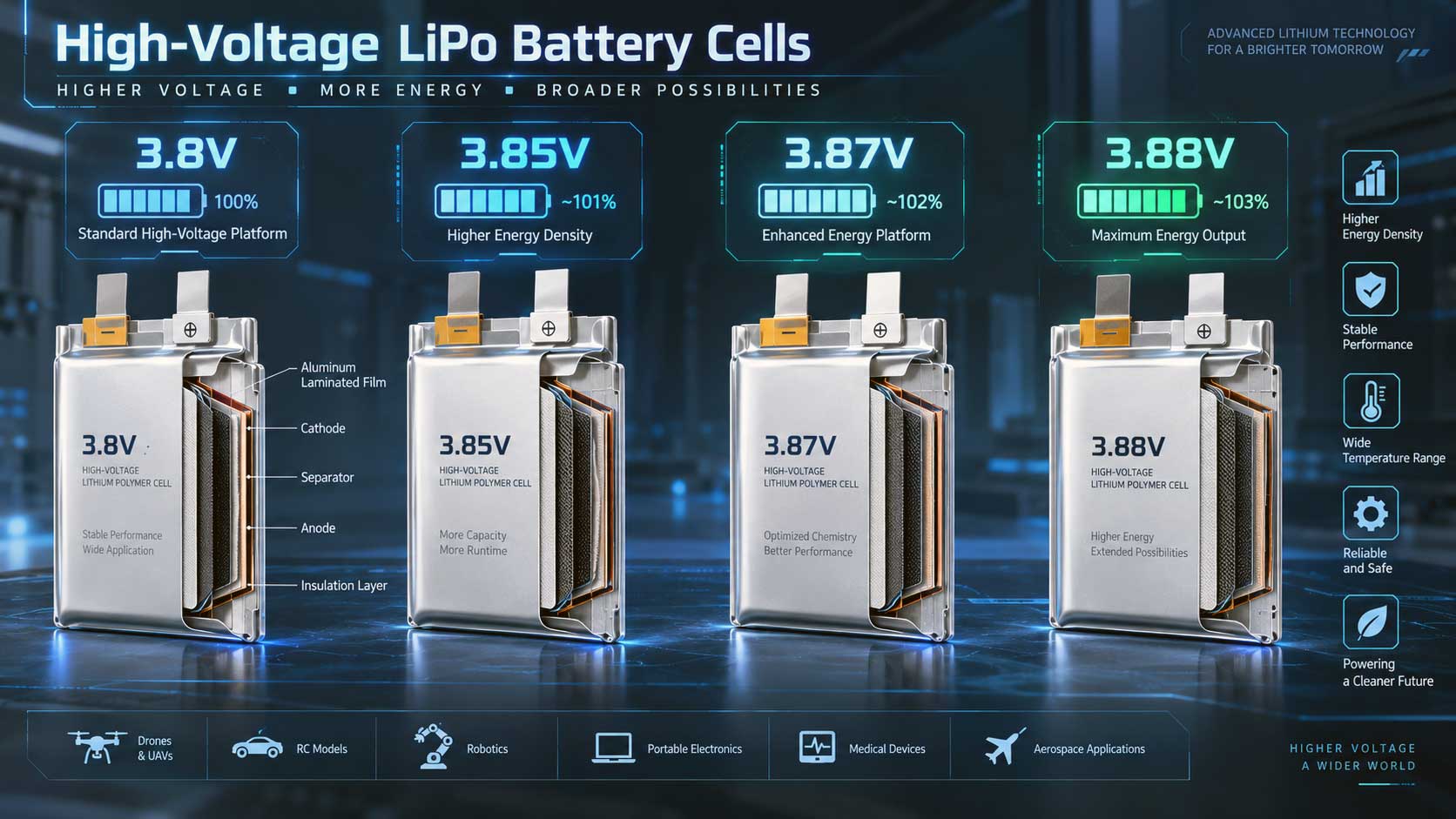
An HV LiPo Battery is not limited to one voltage specification. Depending on cell chemistry and manufacturer design, high-voltage lithium polymer cells may be rated at 3.8V, 3.85V, 3.87V or 3.88V nominal voltage, with charging limits commonly extending beyond the traditional 4.20V LiPo level. Understanding these differences is important when selecting a battery for compact electronics, wearables, drones, robotics and other energy-sensitive applications.
What Is an HV LiPo Battery?
A conventional lithium polymer cell is commonly identified by a nominal voltage around 3.6V to 3.7V and a maximum charging voltage of approximately 4.20V. An HV LiPo, also called a LiHV battery, uses a cell chemistry designed to operate at a higher voltage platform.
The important point is that “HV” describes a family of high-voltage lithium polymer cells rather than one universal specification. Different cell designs can have different nominal voltages, charge cut-off voltages, discharge curves and recommended operating conditions.
Common HV LiPo Voltage Families
| Cell Type | Typical Nominal Voltage | Common Charge Limit | General Description |
|---|---|---|---|
| Standard LiPo | 3.6V–3.7V | 4.20V | Conventional lithium polymer voltage platform |
| HV LiPo | 3.80V | Often 4.35V | Widely used high-voltage LiPo platform |
| HV LiPo | 3.85V | Often 4.40V | Common in high-energy compact applications |
| HV LiPo | 3.87V | May reach 4.45V | Higher-voltage chemistry used in selected cell designs |
| HV LiPo | 3.88V | May reach 4.45V | Used in smartphones and other compact high-energy systems |
These figures are useful references, not universal charging rules. A 3.85V, 3.87V or 3.88V marking does not by itself authorize charging to a particular voltage. Cell chemistry and manufacturer specifications always take priority.
Why Use a Higher-Voltage LiPo Cell?
The main attraction of an HV LiPo battery is the opportunity to store more usable energy within a limited battery volume and operate at a higher discharge voltage platform. This is particularly valuable where engineers cannot simply increase battery dimensions or weight.
However, higher nominal voltage does not automatically mean a battery is better. Actual performance also depends on capacity, internal resistance, electrode design, temperature, discharge current, cycle requirements and pack construction.
Typical Applications
- Smartphones and handheld electronics
- Wearable devices and smart rings
- Portable medical and monitoring equipment
- IoT and GPS devices
- Drones and lightweight UAV systems
- Robotics and mobile electronic platforms
- Custom compact battery-powered products
Different applications may favor different HV chemistries. Consumer electronics often prioritize maximum energy within a small enclosure, while UAV and robotics projects may place greater emphasis on discharge capability, temperature behavior and pack weight.
How to Select an HV LiPo Battery
1. Confirm Maximum Charge Voltage
Check the cell datasheet first. A charger must support the exact charge cut-off voltage required by the selected battery.
2. Check System Voltage Compatibility
Design electronics around the fully charged pack voltage, not only the nominal voltage printed on the label.
3. Compare Energy, Not Only mAh
Battery energy is commonly expressed in watt-hours. Two cells with the same mAh capacity but different nominal voltages do not contain exactly the same nominal energy.
4. Review Current and Thermal Requirements
Continuous current, peak current, internal resistance and operating temperature must match the real load. This is especially important for drones, motors and other high-power systems.
5. Verify Size and Pack Design
Thickness, width, length, connector, protection circuit, NTC, wire size and pack configuration should all be confirmed before production.
Charging HV LiPo Batteries Safely
A charger configured for a conventional 4.20V LiPo cell should not automatically be used to charge an HV cell to its maximum voltage, and an HV charging mode should never be applied to a standard LiPo cell.
Use the charging voltage, current, temperature range and termination conditions specified for the actual cell. When cells are connected in series, proper voltage monitoring and balancing become even more important.
Final Thoughts
The term HV LiPo Battery covers more than the familiar 3.8V LiHV cell. Today‘s high-voltage polymer battery market includes 3.8V, 3.85V, 3.87V and 3.88V cells, together with several different upper charging-voltage platforms.
For engineers and buyers, the best approach is to treat nominal voltage, charge cut-off voltage, capacity, discharge capability and physical dimensions as separate specifications. Selecting the right combination produces a much more reliable battery solution than choosing a cell simply because it is labeled “HV.”
Need a Custom HV LiPo Battery?
When evaluating an HV LiPo solution, prepare your required nominal voltage, maximum system voltage, capacity, continuous and peak current, battery dimensions, connector, protection requirements and operating temperature. These parameters make it easier to identify whether a 3.8V, 3.85V, 3.87V, 3.88V or another high-voltage cell platform is appropriate for the application.
