







Lithium Battery Over-discharge Test: What It Reveals About Battery Safety
A lithium-ion battery normally spends its working life between carefully defined upper and lower voltage limits. Charge too far above the upper limit and the cell enters an overcharge condition. Push it below its specified discharge limit and a different problem begins: over-discharge.
That is why a Lithium Battery Over-discharge Test is more than a simple exercise in draining a battery until the voltage reaches zero. A properly designed test helps engineers understand how the cell, protection circuit, battery management system (BMS), and complete battery pack respond when normal discharge control no longer works as intended.
For battery designers and product engineers, the real questions are practical: Does the protection circuit disconnect the load at the intended point? What happens if one cell in a series pack empties before the others? Does the cell heat, swell, vent, or suffer permanent internal damage? And what happens when someone later attempts to recharge it?
What Is Lithium Battery Over-discharge?
Over-discharge occurs when a rechargeable lithium cell is discharged below the lower voltage boundary specified for that cell chemistry and design. The exact voltage is not universal. It depends on factors such as electrode chemistry, cell construction, manufacturer specifications, protection strategy, load conditions, and the intended application.
This point is important because a statement such as “every lithium battery must stop discharging at exactly X volts” is usually too simplistic. An LFP cell, an NMC cell, a lithium-polymer pouch cell, and a specialized industrial lithium cell may all have different operating limits.
Engineering rule: the correct lower discharge limit should come from the cell manufacturer‘s specification and the safety requirements applicable to the finished battery or end product—not from a generic voltage number found online.
Why Is Over-discharge a Safety Concern?
At first glance, an empty battery may appear less hazardous because it contains less immediately available electrical energy. Electrochemically, however, forcing a lithium-ion cell substantially below its intended operating range can create irreversible changes inside the cell.
Research on lithium-ion over-discharge has associated severe conditions with degradation of the solid electrolyte interphase (SEI), electrolyte-related side reactions, gas generation, increased impedance, and dissolution of the copper current collector. Under sufficiently severe conditions, dissolved copper may later redeposit inside the cell, creating a potential pathway toward internal short circuits.
The important lesson is that damage caused during over-discharge may matter when the cell is subsequently recharged. A battery that appears quiet immediately after an abuse event should not automatically be assumed to be healthy.
| Over-discharge Effect | What May Happen | Why Engineers Monitor It |
|---|---|---|
| SEI degradation | Protective interfacial layers may deteriorate and reform during later charging. | Can contribute to irreversible capacity loss and increased side reactions. |
| Capacity loss | Some active lithium and electrode capacity may no longer be recoverable. | The cell may no longer meet its original performance specification. |
| Impedance increase | Internal resistance may rise after severe discharge abuse. | Higher resistance can increase voltage drop and heat generation under load. |
| Gas generation / swelling | Side reactions can generate gas in some cell designs. | Especially important for pouch and prismatic cells. |
| Copper dissolution | The negative-electrode copper current collector may become unstable during severe over-discharge. | Subsequent metal deposition can increase internal-short risk. |
| Cell reversal | A depleted cell in a series string can be driven into reverse polarity by other cells. | This is one reason forced-discharge testing is important in multicell systems. |
Over-discharge, Deep Discharge and Forced Discharge Are Not the Same Thing
These terms are often used interchangeably in casual battery discussions, but they describe different situations. Keeping them separate makes test specifications much clearer.
| Term | Meaning | Typical Context |
|---|---|---|
| Deep discharge | Using a large portion of the battery‘s available capacity. | It may still remain within the manufacturer‘s permitted operating range. |
| Over-discharge | Discharging below the specified lower operating limit. | Protection design, fault analysis, battery abuse evaluation. |
| Forced discharge | A depleted cell is forced to continue carrying discharge current, potentially into voltage reversal. | Safety standards and series-cell imbalance evaluation. |
For example, imagine several cells connected in series. Manufacturing tolerances, aging, temperature differences, or cell imbalance can cause one cell to reach an empty state before its neighbors. If the load continues drawing current, the remaining cells can effectively drive current through the depleted cell. Its voltage can fall toward zero and, in severe cases, reverse polarity.
This is the type of abnormal condition that a forced discharge test is intended to investigate.
How Does a Lithium Battery Over-discharge Test Work?
There is no single test procedure that applies to every lithium battery. The method should be selected according to the relevant standard, cell type, pack design, target market, and end-product requirements.
A development-level test program commonly follows a structure similar to the one below.
1. Define the Test Sample
Engineers first document the battery configuration, chemistry, rated capacity, nominal voltage, lower discharge limit, protection circuit configuration, BMS settings, and cell arrangement.
For multicell packs, cell-level voltage measurement is particularly valuable because pack voltage alone can hide an individual weak cell.
2. Establish the Required Initial Condition
Depending on the applicable procedure, cells may need to be charged, discharged, aged, rested, or stabilized at a specified temperature before testing begins.
This conditioning step matters. Two batteries with different initial states of charge may behave very differently under the same external load.
3. Apply the Abnormal Discharge Condition
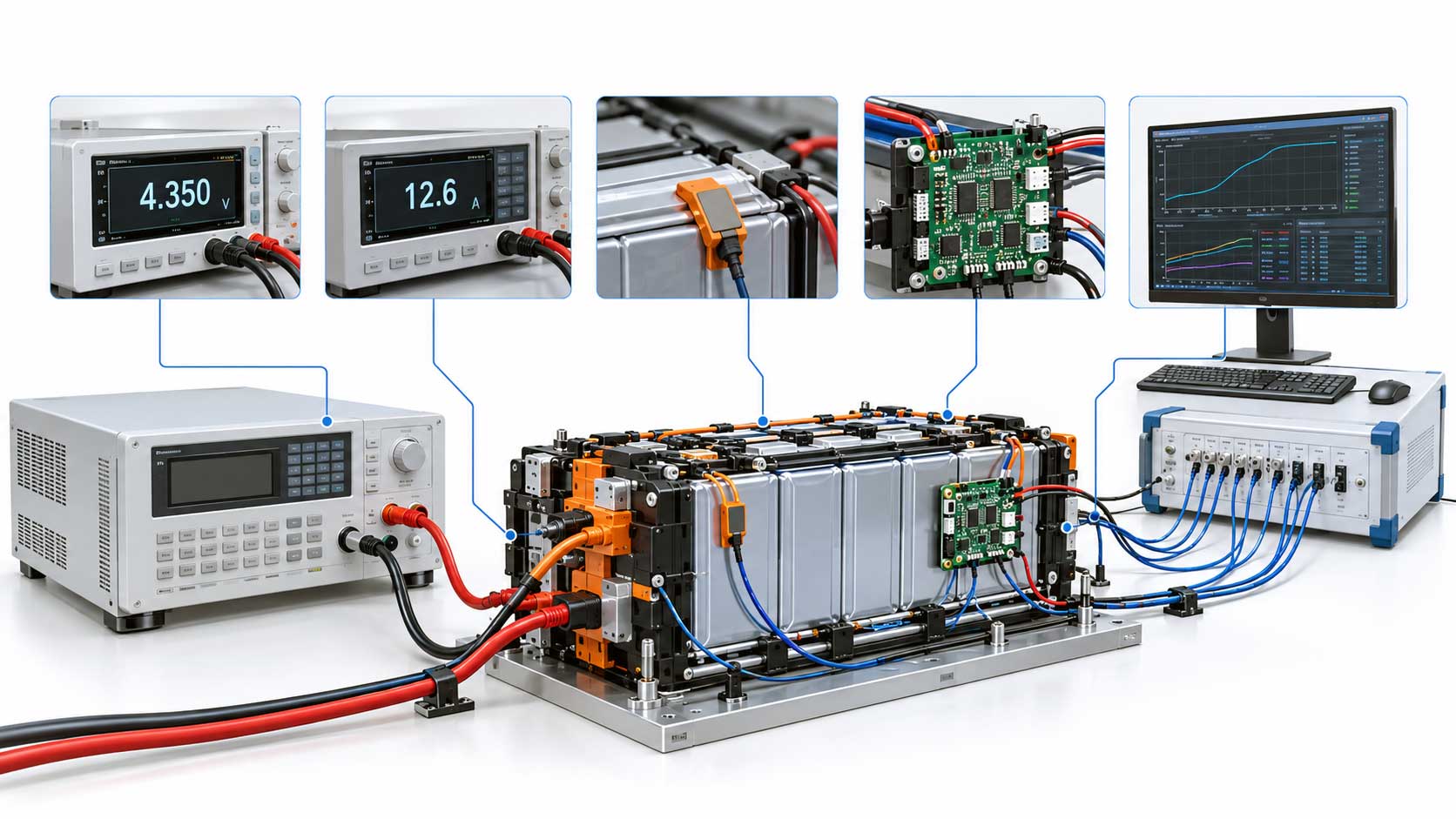
A programmable battery cycler or electronic load is normally used so that current, voltage, time and termination conditions can be controlled and recorded accurately.
In a forced-discharge evaluation, the method may intentionally simulate what happens when a depleted cell remains in a series circuit while current continues to flow.
4. Monitor Electrical and Thermal Behavior
Useful measurements commonly include:
- individual cell voltage;
- overall battery-pack voltage;
- discharge current;
- cell surface temperature;
- test duration;
- protection-circuit activation;
- voltage reversal, where applicable;
- swelling or deformation;
- venting, leakage, smoke or unusual odor;
- fire or rupture;
- post-test open-circuit voltage and impedance where required.
5. Inspect the Battery After Testing
The test does not necessarily end when the electronic load switches off. Post-test observation can reveal swelling, delayed temperature changes, mechanical deformation or abnormal voltage recovery.
Whether the battery should subsequently be recharged is determined by the formal test procedure or controlled engineering investigation. A severely over-discharged production battery should not simply be connected to a charger to “see if it still works.”
What Does a Typical Over-discharge Voltage Curve Look Like?
The graph above deliberately avoids assigning a universal voltage value to the lower limit. That is because lithium battery chemistries do not share one universally safe cutoff voltage.
A test engineer should instead work from the approved cell specification and applicable safety standard.
What Should Engineers Look for During the Test?
A useful over-discharge test does more than produce a final “pass” or “fail” result. Development engineers should study how the battery reaches that result.
| Measurement | What It Can Reveal |
|---|---|
| Cell voltage | Shows when an individual cell approaches its lower limit or enters reversal. |
| Pack voltage | Provides overall system behavior but may conceal cell imbalance. |
| Current | Confirms the intended electrical abuse condition was actually applied. |
| Temperature | Identifies abnormal heat generation during or after discharge. |
| Protection cutoff timing | Helps validate BMS or PCM threshold, delay and switching behavior. |
| Physical appearance | Can reveal swelling, leakage, venting or mechanical deformation. |
| Post-test impedance | May reveal degradation not obvious from external appearance. |
| Residual capacity | Helps quantify permanent performance damage where the test program requires it. |
Why BMS Over-discharge Protection Matters
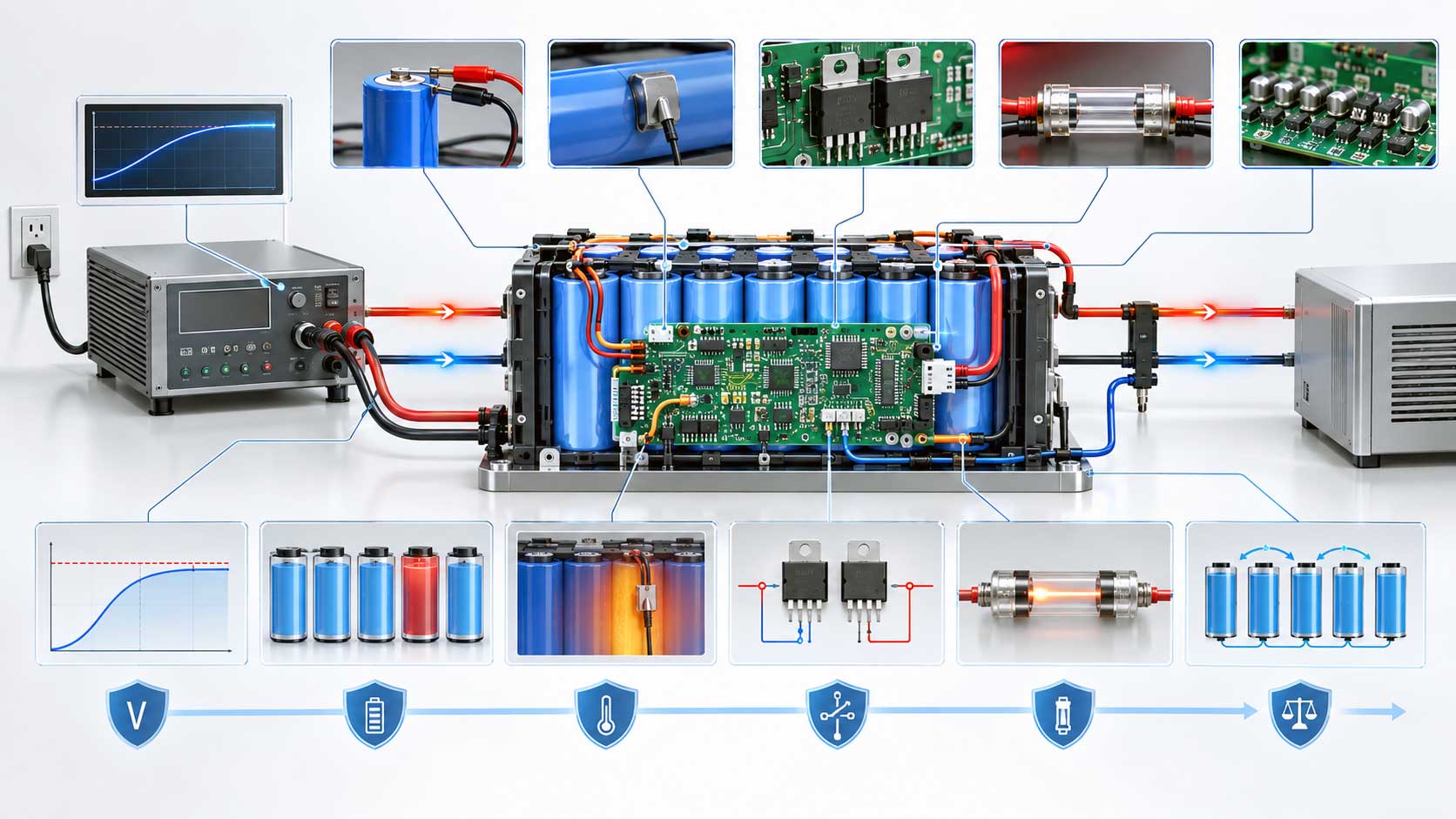
In a properly engineered rechargeable battery pack, the BMS or protection circuit is normally the first line of defense against excessive discharge.
A good design does not rely on a single voltage number. Engineers also consider measurement tolerance, filtering, protection delay, MOSFET behavior, cell imbalance, temperature, standby current and the behavior of the battery after the protection circuit has opened.
Important BMS Parameters Include
- Over-discharge detection voltage: when the protection system recognizes an undervoltage condition.
- Detection delay: how long the abnormal voltage must remain before protection operates.
- Release or recovery voltage: the condition required before the battery can leave its protected state.
- Cell-voltage measurement accuracy: especially important in series battery packs.
- Protection MOSFET behavior: whether the discharge path is reliably isolated.
- Quiescent current: because the BMS itself continues consuming a small amount of energy during storage.
- Cell balancing: helping reduce the chance that one cell reaches its lower limit significantly earlier than the others.
The last point is easily overlooked. A battery placed into storage with very little remaining charge can continue to lose energy through self-discharge and the electronics‘ standby consumption. Months later, cells may have fallen well below the intended storage range even though the product was never actively used.
Over-discharge Protection Does Not Mean the Battery Is Impossible to Over-discharge
A protection IC substantially reduces risk, but designers still need to think about realistic fault conditions.
Examples include:
- failed or bypassed protection MOSFETs;
- incorrect BMS configuration;
- voltage-sensing errors;
- poorly matched cells in a series pack;
- excessive self-discharge;
- long-term storage at very low state of charge;
- parasitic current from connected electronics;
- unexpected external loads;
- damaged wiring or assembly errors;
- a charger attempting to recover a deeply discharged cell incorrectly.
Safety evaluation therefore looks at the complete system rather than assuming that the presence of a BMS alone makes abnormal discharge impossible.
Lithium Battery Over-discharge Test Standards
The required standard depends on the product, cell configuration, market and intended application. Three frequently encountered references are shown below.
| Standard / Framework | Typical Relevance | Important Note |
|---|---|---|
| IEC 62133-2 | Safety requirements for portable sealed secondary lithium cells and batteries. | Includes safety testing for reasonably foreseeable misuse, including cell-level forced-discharge considerations. The applicable edition should be confirmed for the target certification market. |
| UN Manual of Tests and Criteria, Section 38.3 | Transport testing for lithium cells and batteries. | T.8 is the Forced Discharge test and applies to cells. T.7 covers overcharge of rechargeable batteries. UN 38.3 should not simply be described as having a generic pack-level “over-discharge test.” |
| UL 1642 / related UL battery standards | Safety evaluation of lithium cells and batteries within the scope of the relevant UL standard. | Applicable electrical-abuse tests depend on the battery construction, intended product and certification path. |
IEC currently identifies IEC 62133-2:2017 + AMD1:2021 as the consolidated version covering safety requirements and tests for portable sealed secondary lithium cells and batteries.
For transport, the United Nations publishes lithium-cell and battery test requirements in Section 38.3 of the Manual of Tests and Criteria. Engineers should always confirm the latest applicable edition and amendments before beginning a compliance test campaign.
Important: A development test performed inside a battery laboratory is not automatically equivalent to a certification test. Formal certification requires the specified sample preparation, equipment, procedure, documentation and acceptance criteria of the relevant standard and certification body.
Over-discharge Test vs. Overcharge Test
Because the names sound similar, the two tests are sometimes confused. They investigate very different abuse mechanisms.
| Item | Over-discharge Test | Overcharge Test |
|---|---|---|
| Direction | Energy continues to be removed beyond the intended discharge boundary. | Charging continues beyond the intended charge boundary. |
| Primary concern | Cell reversal, electrode degradation, copper dissolution and protection failure. | Excessive electrochemical charging, heat generation and associated safety reactions. |
| Protection involved | Undervoltage / discharge protection. | Overvoltage / charge protection. |
| Typical system trigger | Weak cell, excessive load, long storage, BMS fault or continued series current. | Charger fault, BMS fault, incorrect voltage control or abnormal charge condition. |
| Same test? | No. They require different setups and evaluate different failure mechanisms. | |
Common Mistakes in Lithium Battery Over-discharge Testing
Using Only Pack Voltage
In a multicell battery, total voltage can look reasonable while one weak cell is already significantly below the others. Cell-level logging is often essential during engineering validation.
Assuming Zero Volts Means Zero Risk
Terminal voltage alone does not show everything that has happened internally. Severe electrochemical damage may already have occurred even if the cell is cool and externally intact.
Immediately Recharging a Severely Over-discharged Cell
Attempting to recover an unknown or damaged lithium-ion cell without an appropriate procedure can introduce additional risk. Commercial chargers and battery systems therefore often use carefully controlled low-voltage detection and recovery logic.
Using One Cutoff Voltage for Every Chemistry
A generic cutoff value should never replace the actual cell specification. Chemistry, electrode design and cell manufacturer requirements matter.
Testing Without Recording Temperature
Voltage and current data alone provide an incomplete picture. Temperature can reveal abnormal internal reactions that electrical measurements may not immediately show.
Confusing Product Validation With Certification
An internal engineering test can be extremely useful for product development, but certification requires the exact procedure and acceptance criteria specified by the applicable standard.
What Makes a Good Over-discharge Protection Design?
From a product-development perspective, the goal is not simply to survive a laboratory abuse test. A robust battery system should prevent routine operating conditions from reaching that state in the first place.
A practical design normally combines several layers:
- Suitable cell selection for the expected load and environmental conditions.
- Accurate cell-voltage monitoring, particularly in series-connected packs.
- Independent over-discharge protection where required by the safety architecture.
- Proper discharge MOSFET sizing and fault handling.
- Cell balancing to control divergence between cells.
- Low standby consumption for products that may remain unused for long periods.
- Storage instructions that prevent batteries from being left near empty for excessive periods.
- Controlled low-voltage recovery logic where appropriate.
- Validation under realistic fault conditions, not only ideal laboratory operation.
Frequently Asked Questions
What is a Lithium Battery Over-discharge Test?
It is an electrical safety or engineering test used to evaluate how a lithium cell or battery behaves when discharge continues beyond its normal operating limit. Depending on the standard and configuration, the test may also evaluate a depleted cell being forced to carry current in a series arrangement.
Can a lithium battery recover after over-discharge?
Sometimes a mildly over-discharged cell may appear to recover electrically, but recovery of voltage does not prove that the original capacity, impedance or internal safety condition has been restored. The degree of damage depends on the cell chemistry, depth of over-discharge, duration, temperature and current.
Is an over-discharged lithium battery safe to recharge?
Not automatically. A battery that has fallen below its manufacturer‘s permitted voltage should be handled according to the manufacturer‘s recovery or rejection procedure. Severely over-discharged, swollen, damaged or otherwise abnormal cells should not be casually recharged.
What is forced discharge in lithium batteries?
Forced discharge occurs when current continues to pass through a depleted cell, often because other cells in a series string continue supplying the load. Under severe conditions the depleted cell can be driven into voltage reversal.
Does UN 38.3 include an over-discharge test?
UN 38.3 includes T.8 Forced Discharge for cells. This is the closest standardized transport test to what is sometimes casually called an over-discharge test. It should be referred to by its proper test name when discussing UN transport compliance.
Does IEC 62133-2 cover forced discharge?
IEC 62133-2 addresses the safe operation of portable sealed secondary lithium cells and batteries under intended use and reasonably foreseeable misuse and includes forced-discharge-related cell testing within its safety test framework.
What should be monitored during an over-discharge test?
At minimum, engineers commonly monitor cell voltage, pack voltage, current, temperature, test duration and visible battery behavior. Depending on the objective, post-test impedance, capacity, swelling and recovery characteristics may also be evaluated.
Final Thoughts
The Lithium Battery Over-discharge Test answers an important engineering question: what happens when normal discharge control fails?
For a single cell, the concern is whether excessive discharge causes irreversible electrochemical damage. For a multicell pack, cell imbalance and forced discharge add another layer of complexity. At the system level, engineers must also verify whether the BMS detects the problem early enough and isolates the load as intended.
The strongest battery designs therefore approach over-discharge protection as a system problem involving cell chemistry, electrical protection, BMS logic, cell balancing, standby consumption, storage conditions and product-level validation.
Testing is valuable not because batteries are expected to operate continuously under abuse, but because understanding their behavior outside the normal operating window helps engineers keep real products from getting there.
Technical References
- IEC 62133-2:2017 + AMD1:2021 — Secondary cells and batteries containing alkaline or other non-acid electrolytes — Safety requirements for portable sealed secondary cells, and for batteries made from them, for use in portable applications — Part 2: Lithium systems.
- United Nations Manual of Tests and Criteria, Section 38.3 — Transport test requirements for lithium metal and lithium-ion cells and batteries, including T.7 Overcharge and T.8 Forced Discharge as applicable.
- UL 1642 — Lithium Batteries, UL Standards & Engagement.
- Wang K., et al. The impact of over-discharge on lithium-ion battery performance and safety: Diagnosis and mitigation strategies. Energy Storage Materials, 2025.
Disclaimer: This article is intended for technical education and general engineering reference. It does not replace the latest official text of IEC, UL, UN or other applicable standards. Test conditions, acceptance criteria and certification requirements should always be confirmed against the official standard and the requirements of the relevant certification body.
